

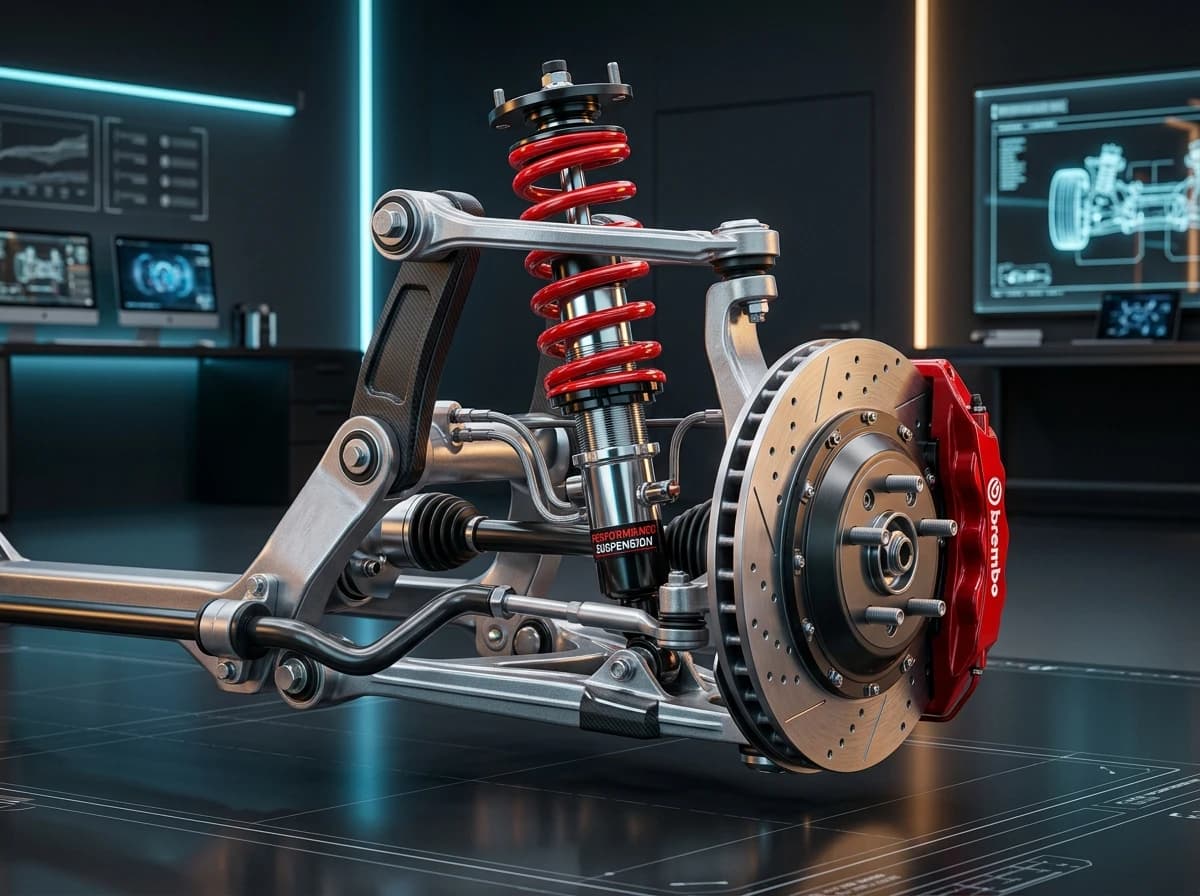
Your car usually tells you when something is wrong. A new noise here, a funny feeling there. These are the signs your suspension needs repair, and catching them early saves you from bigger bills. Here is what to watch for, in plain words.
Key Takeaways
Bouncing, clunking, pulling, and uneven tire wear are the clearest signs your suspension needs repair.
Most causes are worn shocks, struts, bushings, or joints. Small parts that wear out with age and potholes.
Replace shocks and struts in axle pairs, never one side only.
Get a wheel alignment after any suspension work.
A chassis inspection confirms which part is failing. A bounce test alone is not enough.
What Is a Car Suspension?

Think of your car's suspension as the whole team linking your wheels to the frame. Springs, shocks, struts, control arms, bushings, and links, all working together. It soaks up potholes and rough patches, keeps all four tires planted on the road, and keeps the car doing what you ask when you brake, pull away, or turn. Strip it right back and its job is simple: keep you safe and steady on every kind of road.
The 7 Signs at a Glance
Sign | Likely Cause | Severity |
|---|---|---|
Bouncing that does not stop | Worn shocks or struts | Moderate |
Clunking over bumps | Worn bushings, sway bar links, or ball joints | High |
Pulling to one side | Misalignment, uneven tire pressure, or a failing strut | Moderate |
Uneven tire wear | Tired suspension bouncing irregularly | Moderate |
Nose dive when braking | Failed rebound control | High |
Steering feels loose or wanders | Worn tie rod ends or steering rack issues | High |
Leaks or sagging on one corner | Leaking shock or broken coil spring | High |
1. Bouncing That Does Not Stop
Press down on a corner of your car and let go. It should settle after one or two bounces. If it keeps bouncing, your shocks or struts have lost damping resistance. The car will feel floaty on the highway and unstable over bumps.
Damping is what controls how fast the spring compresses and rebounds. When damping fades, the spring keeps oscillating and the tire loses steady contact with the road. That means longer braking distance and less grip in a turn.
What to check: bounce test on all four corners, then a visual check for leaking shocks.
2. Clunking or Knocking Over Bumps
A metallic clunk or knock when you hit a bump or turn usually points to worn bushings, sway bar links, or ball joints. These are small parts, but they hold the suspension together. A noise that starts small gets worse fast, so do not wait for it to go away on its own.
What to check: note when the noise happens. Over bumps points to bushings or links. During turns points to ball joints or sway bar parts.
3. Car Pulls to One Side
If your car drifts left or right on a straight road, or pulls when you brake, the cause could be a geometry misalignment, uneven tire pressure, or a failing strut. Start with tire pressure, since that is free to check. If the pull stays, get the alignment and suspension checked.
A collapsed strut on one side changes ride height and geometry, so the car steers itself off line. Driving on like that wears the tires unevenly and makes emergency handling worse.
4. Uneven Tire Wear
Look at your tread. Cupping (scalloped dips around the tire) or feathering (one edge of each tread block worn smooth) means the tire is bouncing instead of staying planted. Tired suspension wears tires unevenly, and new tires will wear the same way until the suspension is fixed.
Check tread patterns at every tire rotation. Uneven wear is often the earliest visible warning of hidden suspension failure.
5. Nose Dives When Braking or Squats When Accelerating
If the front of the car dives hard when you brake, or the rear squats when you accelerate, the shocks are no longer controlling rebound. Braking distance grows and the car feels unsettled. This is a safety issue, not just a comfort problem.
Rebound control is the shock's job of slowing the spring as it extends. When it fails, weight transfer becomes violent and the car pitches hard under braking and acceleration.
6. Steering Feels Loose or Wanders
A steering wheel that feels loose, heavy, vague, or vibrates at highway speed can point to worn tie rod ends, steering rack trouble, or worn control arm bushings. If the car wanders and needs constant correction, get it checked before a long drive.
Steering and suspension share symptoms. A chassis inspection separates them, since tie rods, rack, and bushings all sit in the same area.
7. Visible Leaks or Sagging on One Corner
Look behind the wheels. Oil weeping or dripping down the body of a shock or strut means the seal has failed. And if one corner of the car sits lower than the rest, a coil spring may be broken or weak. Both need attention, not a top-up.
An axle pair means the two matching units on one axle, front or rear. Always replace them together.
Suspension Repair Costs
Service | Typical Cost | Notes |
|---|---|---|
Shock / strut pair | $150 – $900+ per axle | Economy and midsize cars $150 – $500. Trucks, SUVs, and luxury $300 – $900+. Hardware and mounting kits included. |
Full overhaul | $1,000 – $2,500+ total system | Full set of springs and shocks, control arms and bushings restored, sway bar links and joints installed. |
Wheel alignment | $75 – $200 post-service | Standard 4-wheel alignment $75 – $140. Essential after any suspension work. |
Prices vary by vehicle, parts, and shop. Get a written quote before authorizing work.
DIY vs Professional Repair

Job | DIY | Professional |
|---|---|---|
Shock absorber replacement | Realistic on many vehicles. Straightforward bolt-on job with basic hand tools and jack stands. | Safer if you lack tools or experience. |
Sway bar links | Commonly serviceable at home. | Quick shop job. |
Coil spring compression | Do not attempt. Extreme safety risk without industrial strut compressors. | Required. |
Wheel alignment | Not possible at home. Needs computerized equipment. | Required after any suspension work. |
Air suspension calibration | Not possible at home. | Required. |
What to Do Next
Do the bounce test on all four corners. It flags a problem but it is not conclusive on its own.
Check tire pressure and look at tread wear.
Book a chassis inspection. A professional inspection is the only reliable way to confirm which part is failing.
Replace shocks and struts in axle pairs, never one side only. Mismatched damping hurts handling and wears out the new part faster.
Get a wheel alignment after any suspension work. Skipping it wears out new parts fast.
Suspension Maintenance Schedule

Inspect at every tire rotation. Get a quick visual suspension check every 10,000–12,000 miles during routine service.
Address small noises early. Fix minor squeaks early instead of waiting for them to worsen into structural failures.
Avoid vehicle overloading. Never exceed your car's rated payload capacity to prevent bottoming out and blown dampers.
Always replace in axle pairs. Swap both front or both rear units together to maintain even damping and safe handling.
Monitor tire tread patterns. Uneven wear patterns serve as the earliest warning sign of hidden suspension failure.
Conclusion
If you spotted more than one sign from this list, do not wait. These signs your suspension needs repair only get more expensive with time. Read our complete suspension repair guide to compare costs and options, then contact us to book a chassis inspection. For general vehicle safety guidance, see NHTSA vehicle safety resources.
Frequently Asked Questions
How do I know if my suspension needs repair?
Watch for bouncing after bumps, clunking noises, uneven tire wear, and pulling to one side. A bounce test can raise a flag, but only a professional chassis inspection confirms which component is failing.
Is it safe to drive with a bad suspension?
Short trips at low speed are usually survivable, but a failing suspension increases stopping distance, reduces steering control, and wears out tires and other parts faster. Get it repaired promptly rather than ignoring it.
Can I replace just one shock or strut?
It is not recommended. Replacing only one side leaves mismatched damping between corners, which affects handling and wears out the new part faster. Always replace in axle pairs.
How much does suspension repair cost?
A shock or strut pair typically costs $150 to $900+ per axle, a full overhaul $1,000 to $2,500+, and a wheel alignment $75 to $200 after service. The exact price depends on your vehicle and which parts need replacing.
How often should suspension be inspected?
Most manufacturers recommend a suspension check at every tire rotation or roughly every 10,000 to 12,000 miles, and immediately after hitting a significant pothole or curb.
Can I do suspension repair myself?
Shock absorber replacement and sway bar links are realistic DIY jobs on many vehicles. Coil spring compression, wheel alignment, and air suspension calibration require professional equipment. When in doubt, let a shop handle it.
Does bad suspension wear out tires faster?
Yes. Worn suspension lets tires bounce and skip instead of staying planted, which causes cupping and feathering. New tires will wear the same way until the suspension is fixed.
What causes suspension to fail?
Age, mileage, potholes, overloading, and worn seals all contribute. Shocks lose damping, bushings crack, springs weaken, and joints wear. Regular inspection catches most failures early.

Community Discussion
No comments yet. Have a question about this suspension diagnostic guide? Submit your question below!